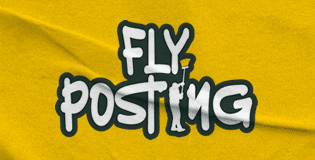

Designing for the street is not the same as designing a flyer someone holds in their hand. A wheat-pasted poster is seen from across a sidewalk, at a glance, often in motion — and usually as part of a cluster competing for the same two seconds of attention. These seven rules are specific to fly posting and Wild Posting®, not generic flyer advice.
1. Design for distance and speed
Assume your poster is read from ten feet away by someone walking past. If the core message isn't legible at arm's length when you shrink the artwork to a thumbnail, it won't work on a wall. Big, confident, simple.
2. One message, one idea
Street posters fail when they try to say everything. Pick a single takeaway — the brand, the drop, the date — and cut the rest. Every extra line of copy competes with the one thing you actually need people to remember.
3. Contrast beats color
Bright colors help, but contrast is what makes a poster readable in daylight, at night under streetlights, and in the corner of someone's eye. Dark type on a light field (or the reverse) will always out-perform a busy, low-contrast design — no matter how beautiful it looks on your screen.
4. Make the type do the work
Typography is the single biggest lever in poster design. Use a strong display face for the headline, keep the hierarchy obvious, and resist the urge to mix more than two fonts. The words are the visual.

5. Build for clustering and repetition
Wild Posting® rarely runs as a single poster — it runs as a run of posters along a corridor. Design with that in mind: artwork that tiles or repeats into a mosaic turns a wall into a statement far bigger than any one sheet. Repetition is what makes the campaign impossible to miss.
6. Give the QR code a reason
A QR code is only worth the space if it offers something — a drop, a discount, a video, a map. "Scan to visit our website" gets ignored. "Scan for 20% off this week" gets scanned. Make the payoff obvious on the poster itself.
7. Keep the brand unmistakable
People should know who the poster is for before they read a word. Lock your logo, colors, and type into a system so that a passer-by — and the people who photograph and share it — instantly connect it to your brand.
Ready to put it on a wall?
Great artwork is half the campaign; the other half is placement. See how we run creative across our industry campaigns and coverage markets, or read the best fly posting campaigns for inspiration. When you're ready, get in touch and we'll help you take it from file to street.


